We Will Help You Apply for Family-Based Visas, Including Spousal Visas, Parent Visas, Fiancé Visas, Consular Processing, and Conditional Green Cards.
Family is the heart of everything. For many, the American dream is not just about personal success; it is about sharing that success with the people you love most. The desire to bring a spouse, parent, child, or sibling to the United States is a powerful and deeply personal goal. It is a journey of hope, uniting loved ones across borders to build a new life together.
We understand that this journey can feel overwhelming. The immigration system is a complex maze of forms, deadlines, and legal terms. A small mistake on an application can lead to long delays or even a denial, causing heartbreak and uncertainty. You are not just filling out paperwork; you are shaping your family’s future. Working with an experienced immigration lawyer can help you avoid these pitfalls and give your family the best chance at success.
Here’s a closer look at the main pathways of family-based immigration and the different types of visas and processes.
What Is Family-Based Immigration?
At its core, family-based immigration is a system that allows United States citizens and lawful permanent residents (also known as green card holders) to sponsor certain family members for a green card. A green card gives a person the right to live and work permanently in the U.S.
The system is divided into two main groups: the Immediate Relative category and the Family Preference category.
- Immediate Relatives: This group is for the closest family members of U.S. citizens. The biggest advantage of this category is that there is no limit to the number of visas that can be issued each year. This means there is no long waiting list based on a quota system.
- Family Preference Categories: This group is for other, more distant family members of U.S. citizens and certain relatives of lawful permanent residents. There are strict annual limits on the number of visas available in these categories. Because of these limits, applicants often face long waiting periods, sometimes for many years.
The group your family member falls into determines how long the process might take.
The Immediate Relative Category: Bringing Your Closest Family to the U.S.
If you are a U.S. citizen, you can petition for your closest relatives to join you in the United States. The law considers these individuals "immediate relatives," and they are given the highest priority.
The three main types of immediate relatives are:
- Spouses of U.S. Citizens
- Unmarried Children (under 21) of U.S. Citizens
- Parents of U.S. Citizens (Petitioner must be at least 21 years old.)
Let’s look at each of these in more detail.
Spousal Visas for U.S. Citizens
Bringing your husband or wife to the U.S. is one of the most common goals in family immigration. To sponsor your spouse, you must be a U.S. citizen and be legally married. The government will require you to prove that your marriage is authentic and not just for immigration purposes.
You will start by filing a petition to establish your marital relationship. During this process, you will need to provide evidence of your life together. This can include documents and items like:
- A marriage certificate
- Photos of you together, including ones taken at your wedding and other life events
- Joint bank account statements
- Joint lease or mortgage documents
- Birth certificates of any children you have together
- Letters from friends and family who can confirm your relationship
Proving your marriage is genuine is the most critical part of the spousal visa process. Gathering strong evidence from the beginning can help make your case much smoother.
Visas for Unmarried Children Under 21
A U.S. citizen can also petition for their unmarried children who are under the age of 21. For immigration purposes, a "child" can be a biological child, a stepchild, or an adopted child, though specific rules apply to each.
The key requirements are that the child must be under 21 and unmarried at the time they receive their green card. The process starts with the U.S. citizen parent filing a petition to prove the parent-child relationship, usually with a birth certificate or adoption decree. Because these visas are not subject to annual caps, the process is generally faster than for older or married children.
Parent Visas
If you are a U.S. citizen and are at least 21 years old, you have the opportunity to sponsor your parents for a green card. You can file separate petitions for your mother and father.
Just like with other immediate relative petitions, you will need to prove your relationship. A birth certificate showing your parent’s name is the most common form of evidence. If you were born outside the U.S. and later became a citizen, you will need to provide proof of your citizenship as well. Sponsoring a parent is a wonderful way to thank them for all they have done and bring your family together under one roof.
The Family Preference Categories: A Pathway for Other Relatives
For family members who do not qualify as immediate relatives, the Family Preference system provides another route. This path is available for certain relatives of both U.S. citizens and lawful permanent residents (LPRs).
Unlike the Immediate Relative category, these categories have annual visa limits. This creates a queue, and applicants must wait for their "priority date" to become current. The wait can be several years, and in some cases, over a decade. The U.S. Department of State publishes a monthly Visa Bulletin that tracks these wait times.
The Family Preference categories are:
- First Preference (F1): For the unmarried sons and daughters (age 21 and over) of U.S. citizens
- Second Preference (F2): This category is for relatives of green card holders and is split into two groups:
- F2A: For spouses and unmarried children (under 21) of LPRs
- F2B: For unmarried sons and daughters (age 21 and over) of LPRs
- Third Preference (F3): For the married sons and daughters of U.S. citizens, along with their spouses and minor children
- Fourth Preference (F4): For the brothers and sisters of U.S. citizens (petitioner must be at least 21 years old), along with their spouses and minor children
The waiting lists for these categories can be long and confusing. It is vital to file the initial petition correctly to establish your place in line and avoid unnecessary delays.
The Fiancé(e) Visa (K-1): A Special Path to Marriage
What if you are not married yet but want your foreign partner to come to the U.S. for your wedding? The K-1 fiancé(e) visa is designed specifically for this situation. This visa allows the fiancé(e) of a U.S. citizen to enter the country for the purpose of getting married.
There are a few key rules for the K-1 visa:
- The petitioner must be a U.S. citizen.
- You must marry your fiancé(e) within 90 days of their arrival in the U.S.
- You must have met in person at least once in the two years before filing the petition, though there are very limited exceptions.
After you are married, your new spouse can then apply for "adjustment of status" to become a lawful permanent resident. The K-1 visa process is unique because it combines non-immigrant travel with an immigrant intent, and it must be followed carefully to ensure success.
Understanding the Immigration Process: Two Main Paths
Once your initial family petition (Form I-130) is approved, your relative will need to apply for their green card. There are two different ways this can happen, depending on where they are living.
Consular Processing
Consular processing is for relatives who are living outside the United States. After the initial petition is approved, the case is sent to the National Visa Center (NVC). The NVC collects the necessary fees and documents, such as financial support forms and civil documents.
Once the NVC has everything, and a visa is available for your relative, the case is forwarded to the U.S. embassy or consulate in their home country. Your relative will then attend a medical exam and an interview with a consular officer. If the interview is successful, their visa will be stamped into their passport, allowing them to travel to the U.S. as a permanent resident.
Adjustment of Status
Adjustment of status is for relatives who are already inside the United States on a valid temporary visa (like a student or tourist visa). If they qualify, they may be able to apply for their green card without leaving the country.
This process allows the person to file their application to "adjust" their status from a temporary visitor to a permanent resident. For immediate relatives of U.S. citizens, this can often be done at the same time the initial family petition is filed. The applicant will usually attend a biometrics appointment (for fingerprints and a photo) and an interview at a local U.S. Citizenship and Immigration Services (USCIS) office.
Choosing the right path is crucial. Trying to adjust status when you are not eligible can have serious consequences. It is important to understand the rules before starting the process.
What Is a Conditional Green Card?
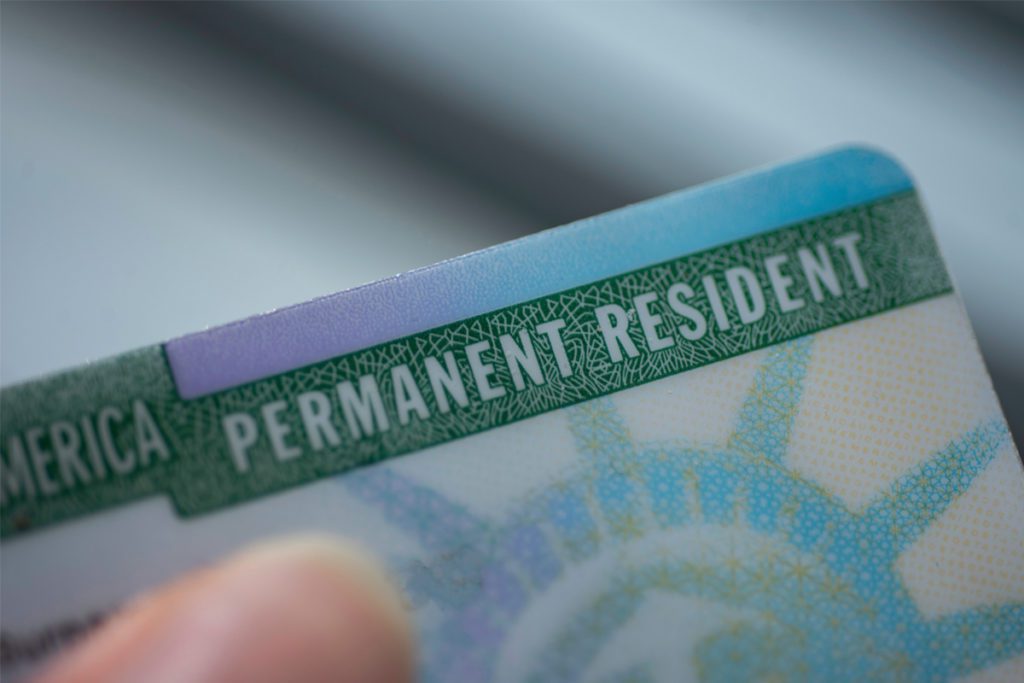
The U.S. government is very focused on preventing marriage fraud—situations in which people get married only to get a green card. To address this, they created the "conditional green card."
If you and your spouse have been married for less than two years on the day your spouse is granted permanent residence, they will receive a conditional green card that is valid for only two years. It provides all the same rights and benefits as a regular 10-year green card, but it comes with an extra step.
Before the two-year card expires, you and your spouse must file a joint petition to "remove the conditions." In this petition, you must once again prove that your marriage is real and that you are still together. You will need to submit new evidence of your shared life, such as updated financial records, insurance policies, and photos.
If the petition is approved, your spouse will receive a full 10-year green card.
Sometimes, life does not go as planned. If the marriage ends in divorce, or if the immigrant spouse was a victim of abuse, it may still be possible to remove the conditions by filing for a waiver. These situations are very sensitive and require careful handling to protect the immigrant’s ability to remain in the U.S.
Common Challenges in Family Immigration
The path to uniting your family can have many obstacles. The process is demanding and requires great attention to detail. Some common challenges include:
- Complex Paperwork: The forms are long and can be confusing. A single missed question or incorrect piece of information can cause major delays.
- Providing Enough Evidence: Proving a family relationship, especially a marriage, requires strong and convincing evidence. It is not enough to simply say you are married; you have to show it.
- Long Wait Times: The waiting periods for the Family Preference categories can be frustrating. It is difficult to wait years for a decision that will shape your life.
- Financial Sponsorship Requirements: Every petitioner must prove they can financially support their relative. If you do not meet the income requirements, you may need to find a joint sponsor, which adds another layer of complexity.
- Changes in Circumstances: Life happens. A divorce, a marriage, or a child turning 21 can change an applicant’s eligibility or visa category, and you need to know how to respond.
These challenges can be stressful and risky. One small error can set your family’s dream back by months or even years, which is why it is wise to have an experienced immigration attorney by your side.
Bailey & Galyen: Trusted Legal Support
We know that this process is about more than just laws and forms. It is about your family, your hopes, and your future. The weight of this responsibility can be heavy, but you do not have to carry it by yourself. Having an experienced and compassionate guide can make all the difference.
For 40 years, the attorneys at Bailey & Galyen have been dedicated to helping individuals and families across Texas and beyond. Our firm was built on a commitment to personal service and a deep understanding of our clients' goals. We know how much is at stake, and we are here to provide the support and guidance you need to navigate the complexities of the immigration system.
Your family’s future is too important to leave to chance. Contact Bailey & Galyen today at (817) 345-0580 or through our online form to schedule a consultation. Let us help you take the first step toward bringing your loved ones home.